The Mathematics of Movement: Analyzing Piece Interactions Across Chess, Backgammon, and Checkers in Online Play
Ben Braun · Jul 26, 2026
The Mathematics of Movement: Analyzing Piece Interactions Across Chess, Backgammon, and Checkers in Online Play
Chess, backgammon, and checkers each rely on distinct mathematical frameworks that govern how pieces interact across boards, and online platforms have made these patterns easier to track through data collection and algorithmic analysis. Researchers have examined movement as a series of graph-based decisions where positions connect through legal transitions, while probabilities shape outcomes in games that incorporate chance elements. In July 2026 online servers reported sustained growth in multiplayer sessions across these titles, with platforms logging millions of completed matches that feed into studies of optimal play.
Graph Theory and Position Mapping in Chess
Chess positions form directed graphs where each node represents a board state and edges correspond to legal moves, allowing analysts to calculate branching factors that average around 35 per turn in the opening phase. Software used on major online sites processes these graphs to evaluate piece interactions, such as how knights control squares of opposite colors or how bishops remain confined to diagonal paths. Data from competitive servers shows that central control correlates with reduced opponent mobility, a pattern quantified through centrality measures in network analysis. Observers note that endgame tables, built from retrograde analysis, map every possible configuration within databases exceeding 100 terabytes, revealing forced wins or draws when material reaches limited thresholds.
Probability Distributions and Dice Interactions in Backgammon
Backgammon introduces stochastic elements through dice rolls, where the 36 possible outcomes distribute across pip combinations that determine checker movement and hitting opportunities. Analysts model the board as a state machine in which each point holds a certain number of checkers, and transitions occur according to the sum or individual values shown on the dice. Online play records from 2025 indicate that bearing-off sequences follow predictable probability curves, with players who calculate race equities gaining measurable edges in long matches. Researchers have applied Markov chains to bear-off positions, calculating exact winning percentages when checkers remain on specific points, and these figures integrate directly into bots that compete against human users on digital tables.
Grid-Based Interactions and Jump Mechanics in Checkers
Checkers operates on an 8x8 grid with forced capture rules that create chains of jumps, each chain representing a sequence of state changes governed by adjacency conditions. Mathematical models treat the board as a bipartite graph separating dark and light squares, since pieces move only on one color. Studies of online databases reveal that king promotions occur at rates tied to the number of remaining pieces, and endgame positions with three kings against two follow established win percentages derived from exhaustive search. Platforms hosting these games log every move, enabling pattern recognition that identifies when a player overlooks a multi-jump sequence and thereby alters the interaction balance between opposing forces.
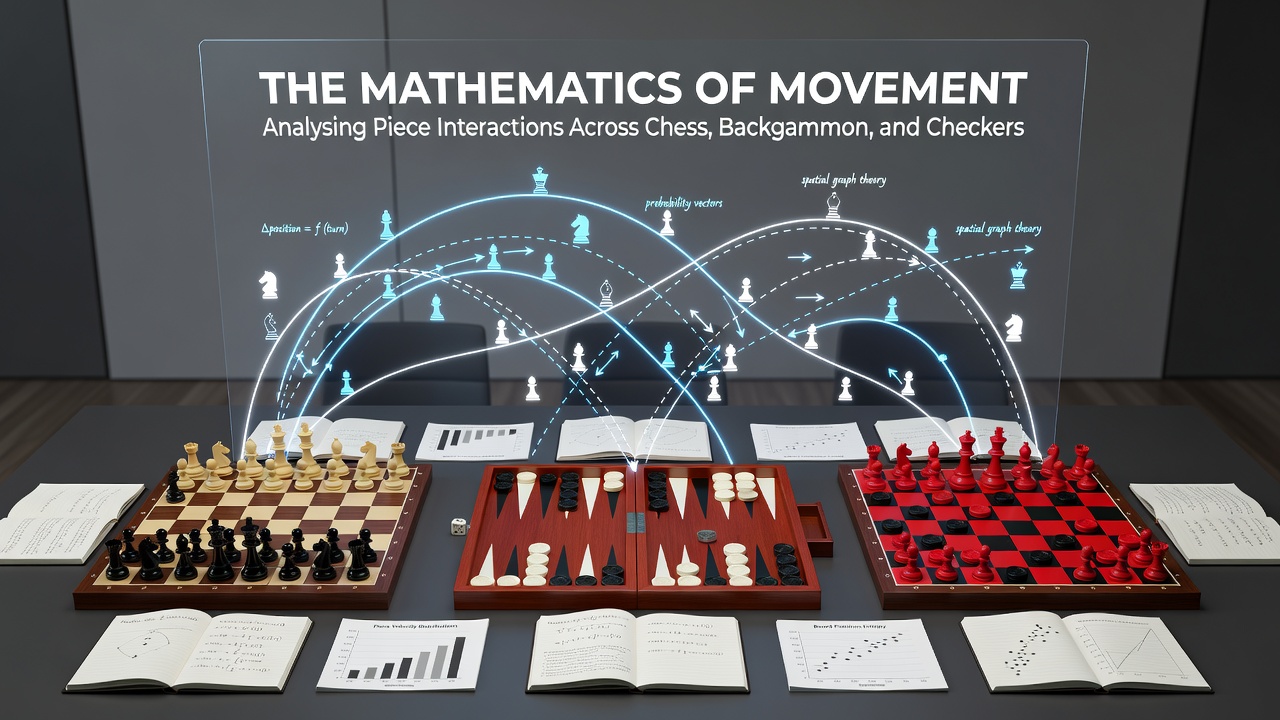
Comparative Metrics Across the Three Games
When researchers compare the three games, they track metrics such as average decision complexity, state-space size, and interaction density per move. Chess exhibits the largest state space, estimated at 10^43 legal positions, whereas checkers reaches approximately 5x10^20 and backgammon occupies a smaller but continuous space due to dice variability. Online platforms apply similar evaluation functions across titles, weighting material, position, and mobility, yet backgammon requires additional layers that account for cube decisions and match equity. Figures from international gaming associations show that users who study these metrics through built-in tools improve their win rates at rates documented in session logs spanning multiple months.
Academic institutions in Canada and Australia have published joint reports on how digital interfaces influence movement precision, noting that players using analysis overlays adjust their piece placement patterns more rapidly than those relying solely on intuition. These reports link to datasets hosted by university repositories that detail transition probabilities between midgame and endgame phases. One study released in early 2026 examined over 2 million online matches and identified recurring motifs where certain piece configurations recur across all three games when reduced to simplified boards.
Algorithmic Applications in Modern Online Environments
Modern servers integrate Monte Carlo tree search and neural network evaluations that simulate millions of movement sequences per second, allowing real-time feedback on piece interactions during live play. These systems treat each game as a search problem where pruning techniques eliminate branches that fall below evaluation thresholds. Data aggregated across European and North American platforms demonstrates that games completed under time controls exhibit different interaction profiles than untimed matches, with faster play favoring aggressive mobility over long-term positioning. Observers have recorded instances where bots trained on one title transfer partial knowledge to another, particularly in recognizing blocking structures that appear in both backgammon primes and checkers formations.
Conclusion
Mathematical analysis of movement continues to shape how players and developers approach chess, backgammon, and checkers on digital platforms. By mapping positions as graphs, calculating probabilities, and logging millions of interactions, online environments provide the raw material for deeper understanding of these classic games. Continued data collection through 2026 and beyond supports refinement of both human strategies and algorithmic opponents without altering the fundamental rules that define each title.